


Blog

18/08/2023
When it comes to thermal analysis experiments, the question of whether thermal analysis crucibles can be reused or should be discarded after each experiment is a common concern. Thermal analysis is a crucial technique used to study the physical and chemical properties of materials as they undergo temperature changes. In this article, we delve into the science behind thermal analysis crucibles, weighing the pros and cons of reusing them and providing expert insights to guide your approach.

17/08/2023
In the realm of material research, where precision and accuracy are paramount, TGA crucibles play an indispensable role. These tiny vessels might seem unassuming, but their impact on material analysis is far-reaching and profound. What exactly are TGA crucibles, and why are they so vital in material research? In this comprehensive guide, we delve into the intricacies of TGA crucibles and explore their significance in the pursuit of scientific knowledge.

10/08/2023
A Thermogravimetric Analysis (TGA) crucible is a pivotal apparatus within the realm of thermal analysis, specifically designed to elucidate the intricate aspects of a material's thermal stability and degradation kinetics.

08/08/2023
In the realm of material analysis, the Tzero sample press stands as an invaluable companion to the rheometer, an essential instrument tailored to gauge the flow and deformation characteristics of diverse materials. The seamless integration of the Tzero sample press with a rheometer marks a pivotal advancement in experimental techniques, elevating the precision and reliability of rheological evaluations. This article delves into the pivotal role of the Tzero sample press, elucidating its purpose and benefits in tandem with its synergy with rheometers.

04/08/2023
Thermogravimetric Analysis (TGA) is an invaluable analytical technique used to measure changes in the weight of a sample as a function of temperature or time. Its applications span diverse fields, including material science, pharmaceuticals, and environmental analysis.
31/07/2023
Thermogravimetric Analysis (TGA) is a powerful analytical technique used to investigate the weight changes of a material as a function of temperature or time in a controlled environment. TGA has found widespread applications in various industries, from pharmaceuticals to petrochemicals, due to its ability to provide valuable insights into thermal stability, composition, and decomposition processes of different materials. In this article, we will delve into the significance of temperature in TGA experiments and its influence on weight loss.

27/07/2023
Differential Scanning Calorimetry (DSC) is a versatile and widely used thermal analysis technique that provides valuable insights into the thermal behavior of materials. By measuring the heat flow between a sample and a reference material under controlled temperature conditions, DSC generates characteristic curves known as DSC curves. These curves hold essential information about phase transitions, chemical reactions, and thermal properties, enabling researchers to understand the behavior of various substances. In this article, we will explore the interpretation of DSC curves and how to gain a comprehensive understanding of the results obtained through this powerful analytical technique.
%20Principle-356x244.jpg)
25/07/2023
Differential Scanning Calorimetry (DSC) is a powerful thermal analysis technique that unlocks the secrets of material behavior. It measures heat flow during phase transitions, reactions, and thermal events, providing valuable insights into the properties and stability of various substances.
This article is a comprehensive guide to interpreting DSC graphs, identifying phase transitions, and quantifying enthalpy changes. It also addresses common issues in DSC measurements and offers expert troubleshooting techniques for accurate results.
Exploring advanced techniques like Modulated DSC and Evolved Gas Analysis expands the possibilities for in-depth sample analysis.
Additionally, we will explore the wide-ranging applications of DSC in pharmaceuticals, polymers, food, and nanotechnology, showcasing its versatility in diverse industries.
Lastly, we'll touch on the future developments in DSC technology, promising improved portability, streamlined data analysis, and seamless integration with other analytical techniques.
21/07/2023
Differential Scanning Calorimetry (DSC) is a powerful analytical technique widely used in various scientific and industrial fields to study the thermal behavior of materials. In this article, we will explore the basic principles behind Differential Scanning Calorimetry, its working mechanism, applications, and the significance it hols in scientific research.
18/07/2023
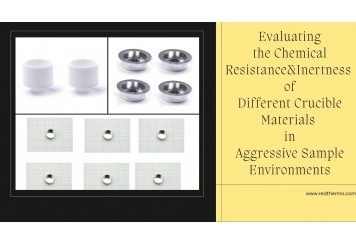
Crucibles play a vital role in various industries, laboratories, and research facilities, where they are used for holding and heating samples during chemical processes. When working with aggressive sample environments, it becomes essential to evaluate the chemical resistance and inertness of different crucible materials. This article will explore the significance of chemical resistance and inertness in crucibles, the factors that influence material selection, and the evaluation methods used to assess their performance in aggressive environments.