


Blog

13/07/2023
In the field of materials science and thermal analysis, Differential Scanning Calorimetry (DSC) is a powerful technique used to study the thermal properties of various substances. One crucial aspect of conducting an accurate DSC analysis is the proper sealing and preparation of the crucible. This article will guide you through the essential steps and techniques required to master the art of sealing and preparing a crucible for accurate DSC analysis.

11/07/2023
In material science research, Thermal Gravimetric Analysis (TGA) is a valuable technique for studying the properties of various materials. TGA crucibles, which provide a controlled environment for heating and weighing the sample, play a crucial role in this analysis. While TGA crucibles can be made from different materials, such as alumina, aluminum, and platinum, it is important to consider the advantages and disadvantages specific to each material. In this article, we will explore the advantages and disadvantages of using TGA crucibles that are made from alumina, aluminum, and platinum in material science research.

06/07/2023
In recent years, the use of thermogravimetric analysis (TGA) crucibles and the study of degradation kinetics have gained significant attention in various industries and research fields. TGA crucibles, also known as thermogravimetric crucibles, are essential tools in thermal analysis. They play a crucial role in measuring the weight changes of a sample as it is subjected to controlled temperature conditions. This article will delve into the applications of TGA crucibles and the significance of degradation kinetics in different industries and research areas.

04/07/2023
Thermal stability analysis plays a crucial role in understanding the behaviour of polymers under different temperature conditions. One widely used technique for such analysis is Thermogravimetric Analysis (TGA), which measures the weight changes of a material as a function of temperature. To conduct TGA experiments, a TGA crucible is used to hold the sample and provide controlled heating. In this article, we will guide you through the process of using a TGA crucible to analyze the thermal stability of polymers.
29/06/2023
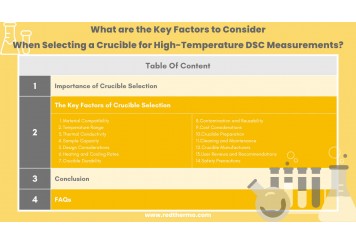
When it comes to conducting high-temperature Differential Scanning Calorimetry (DSC) measurements, selecting the right crucible is of utmost importance. The crucible serves as a container for the sample material during the analysis and plays a crucial role in obtaining accurate and reliable results. In this article, we will explore the key factors that should be considered when choosing a crucible for high-temperature DSC measurements. By understanding these factors, you will be able to make an informed decision and optimize your thermal analysis experiments.

27/06/2023
Thermal analysis crucibles play a crucial role in the field of material characterization, specifically in Differential Scanning Calorimetry (DSC) measurements. These small containers are designed to withstand high temperatures and provide a controlled environment for samples during thermal analysis experiments. In this article, we will explore the significance of thermal analysis crucibles and delve into their functioning within DSC measurements.
21/06/2023
Are you familiar with thermogravimetric analysis (TGA) and the mass loss curves it produces? If you've ever conducted TGA crucible analysis, you know that interpreting the resulting mass loss curves can be crucial in understanding the behavior of materials under varying temperature conditions. In this article, we will guide you through the process of interpreting mass loss curves obtained from TGA crucible analysis, helping you gain valuable insights from your experimental data.

19/06/2023
In food analysis, Thermal Gravimetric Analysis (TGA) is an invaluable technique for determining the composition and thermal stability of various food components. TGA involves subjecting a sample to controlled temperature conditions while measuring the weight changes due to thermal decomposition, volatilization, or other physical or chemical reactions. This article will provide a comparative review of TGA crucibles, which play a crucial role in food analysis.

15/06/2023
Differential Scanning Calorimetry (DSC) is a widely used technique in material science and research. It measures the heat flow into or out of a sample as a function of temperature or time. Accurate and reliable DSC measurements are crucial for obtaining meaningful data and drawing valid conclusions. One factor that can potentially impact the results of DSC measurements is the choice of crucibles, particularly those made of aluminum. In this article, we will explore the potential effects of aluminum crucibles on DSC measurements and discuss ways to mitigate these effects.

13/06/2023
In differential scanning calorimetry (DSC) analysis, it is crucial to ensure accurate and reliable results. One common challenge that researchers face during DSC experiments is sample leakage, particularly when using aluminum pans and lids. Sample leakage can compromise the integrity of the analysis and lead to erroneous data. In this article, we will explore effective strategies to prevent sample leakage when using aluminum pans and lids in DSC analysis.